
NEWS
IN BRIEF

Pakistan’s rising poverty is not simply a story of low wages, but of wages failing to keep pace with the cost of living. With poverty reaching 28.9%, millions of households are struggling to meet basic needs despite working and earning. The widening gap between the minimum wage and actual household expenses reflects deeper weaknesses in wage policy, labour enforcement and economic security. As inflation, informality and rising costs continue to erode purchasing power, addressing poverty requires more than periodic wage increases—it demands stronger labour protections, targeted social protection and better-paying formal jobs.
SHARE
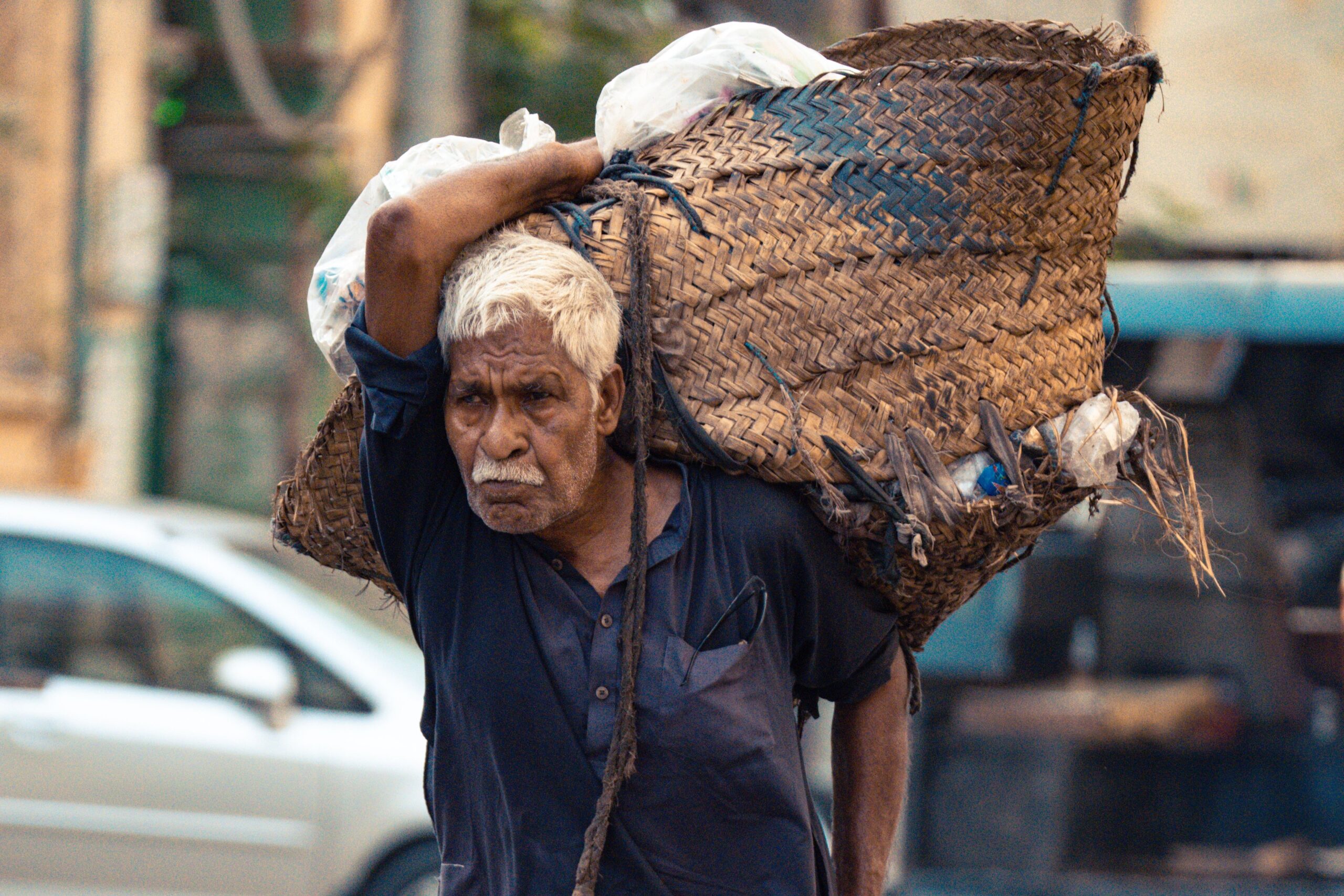
Every morning after Fajr prayer, Asadullah Khan walks two hours to his job as a security guard in Karachi because he cannot afford the bus fare. After working 12 hours in the heat, he walks another two hours home to the one-room flat he shares with his family, paying Rs7,000 in rent. He earns Rs25,000 a month, around a third below the legal minimum wage at the time, yet he was unaware that his pay was below the legal threshold. When asked what he considered a fair wage, he estimated Rs30,000, a figure that itself shows how far workers’ expectations can fall below what is legally required.
Pakistan’s Economic Survey 2025-26 confirms what households have been feeling for years: the national poverty rate has risen to 28.9% in 2024-25, meaning nearly 29 out of every 100 Pakistanis are living below the poverty line. This marks a sharp reversal of more than a decade of progress, during which Pakistan reduced poverty from 50.4% in 2005-06 to 21.9% in 2018-19. The latest increase reflects a significant deterioration in household welfare and highlights the growing economic pressures faced by ordinary Pakistanis.
To put that figure into human terms, around 70 million people are living below Pakistan’s official poverty line of Rs 8,484 per month, a threshold that highlights just how low the benchmark is. That amounts to roughly $30 a month to meet a person’s basic needs, from food and housing to healthcare and other essentials.
The pain is not distributed evenly. Poverty remains significantly higher in rural areas, where the poverty rate stands at 36.2%, compared to 17.4% in urban centres. Provincially, Balochistan recorded the highest poverty rate at 47%, followed by Khyber Pakhtunkhwa at 35.3% and Sindh at 32.6%, while Punjab reported the lowest at 23.3%. Inequality has widened alongside poverty: The Gini coefficient is a measure of income inequality, ranging from 0 (perfect equality) to 1 (perfect inequality). A higher Gini coefficient indicates a more unequal distribution of income, meaning a larger share of total income is concentrated among higher-income groups. In Pakistan, income inequality has widened to a Gini coefficient of 32.7, the highest in 27 years since 1998, while the Planning Commission found nominal incomes rising but real incomes falling, because inflation outpaced earnings.
Minimum wage vs actual living costs
This is where the household-budget arithmetic becomes a national policy problem. The current notified minimum wage in Pakistan’s major provinces is Rs 40,000 per month, but the Pakistan Institute of Development Economics (PIDE) argues that wage policy needs to better reflect rising living costs and economic realities. PIDE’s proposed Rs 45,000 national reference benchmark for 2026-27 is intended to provide a more evidence-based basis for wage setting. Yet raising the official wage alone will not necessarily improve workers’ incomes, particularly in a labour market where informality remains widespread and enforcement of minimum-wage laws is weak. The real challenge, therefore, is not only setting an adequate wage floor but ensuring that workers actually receive it.
Even the Human Rights Commission of Pakistan’s own recommendation of over Rs75,000 a month for a family of six to cover food, housing, utilities, healthcare and education sits far above both the current Rs40,000 wage and PIDE’s proposed Rs45,000 benchmark.
Independent cost-of-living trackers back this up, estimating:
- A single person’s modest monthly budget in Pakistan is roughly Rs 65,000-90,000, even before rent.
- A family of four living modestly needs somewhere in the range of Rs 200,000-350,000 a month once rent, food, utilities, transport, and basic schooling are included.
- Electricity alone consumes a huge share of a household’s budget; bills for a family relying on air conditioning in summer can run Rs 50,000 to Rs 80,000 a month without solar, in a country where the housing, water, electricity, gas, and fuels index rose 16.78% year-on-year as of May 2026.
Lay the minimum wage next to those figures and the gap becomes even more visible. A worker earning Rs 40,000 falls short of even a single adult’s bare-bones budget, long before he tries to feed, house, and educate a family on it.
Why the gap is widening
- Inflation has outrun wages
Falling headline inflation in Pakistan should not be mistaken for a fall in the cost of living. The country is experiencing disinflation, not deflation prices are rising more slowly, but they remain at much higher levels. Although inflation fell to 6.9% in September 2024, cumulative inflation over the previous 44 months had raised prices by 83.13%. Factors such as the base effect, lower global commodity prices, a stable exchange rate and high interest rates contributed to the slowdown, while weaknesses in the Consumer price Index (CPI) methodology may also mean that headline inflation does not fully reflect household costs, particularly for electricity. The government has acknowledged that inflation eroded purchasing power, despite inflation falling from 23.4% in FY2024 to 4.5% in FY2025, and has proposed salary increases, subsidies, skills development and employment measures to restore real wages. However, the key issue remains that lower inflation does not automatically improve living standards when wages and employment opportunities have not kept pace with the higher cost of living.
- Stabilisation policies have squeezed households
Experts at the 8th International Conference on Applied Development Economics in Lahore noted that repeated economic stabilisation policies, including exchange-rate adjustments, privatisation and liberalisation, have reshaped Pakistan’s economy but also contributed to rising poverty by limiting income and employment opportunities. Currency depreciation has further squeezed households by making imported fuel, machinery and essential goods more expensive, while higher fuel and transport costs have increased business production expenses and pushed up consumer prices. At the same time, weak exports, low domestic investment, credit constraints and coordination failures continue to restrict economic growth, making it harder for businesses to expand, create jobs and for households to recover from declining purchasing power.
- The state has limited room to cushion the blow.
Pakistan’s economic stabilisation efforts have placed additional pressure on households as the global energy shock drives up fuel prices and inflation. The sharp increase in petrol and diesel prices has raised transport, food, electricity and production costs, disproportionately affecting low- and middle-income families whose budgets are heavily concentrated on essential goods. Although the government has introduced targeted subsidies for motorcycle users and small farmers, fiscal constraints and IMF commitments have limited its ability to absorb rising costs. With weak exports, high import dependence and declining purchasing power, the combination of currency and fuel price pressures risks pushing vulnerable households deeper into poverty and turning a temporary shock into prolonged economic stagnation.
None of this is unfixable, but the fixes have to go beyond an annual, announcement-only wage bump. Researchers, rights bodies, and the government’s own institutions have converged on a fairly clear set of levers:
- Move to automatic wage indexation, not discretionary announcements
PIDE’s reform proposal argues Pakistan needs a “hybrid” wage-setting formula that combines inflation-indexation (Consumer Price Index(CPI), plus the Sensitive Price Indicator that tracks costs for low-income households specifically) with actual poverty-line and household-survey data so the minimum wage moves automatically with prices instead of being re-litigated, and often frozen, every budget cycle.
The ILO recommends regularly adjusting minimum wages to reflect changes in living costs and economic conditions. Annual adjustments provide predictability, while more frequent or automatic increases can be used when inflation rises sharply. This helps protect workers’ purchasing power while avoiding sudden wage increases that may burden businesses.
- Enforce the wage floor that already exists, especially in the informal sector
Pakistan’s labour market is largely informal, with over 80% of workers outside the documented economy, while weak enforcement leaves many without effective protection despite existing labour laws. Limited inspection capacity, bureaucratic delays and low worker awareness mean that the legal minimum wage often remains unenforced, particularly in the informal sector. Stronger labour inspections and accessible grievance mechanisms are therefore essential to ensure that employers comply with the existing wage floor.
This enforcement is also important for Pakistan’s trade and market access. Pakistan’s commitments under ILO Conventions No. 81 and No. 144, covering labour inspection and tripartite consultation, are also relevant to its preferential trade access such as GSP+ preferences with the EU, which require effective implementation of 27 international conventions. Strengthening workers’ rights and labour enforcement can therefore protect workers while supporting Pakistan’s compliance, preferential market access and export opportunities. This also provides an economic incentive for promoting improvements in labour and worker rights.
- Expand and strengthen targeted cash-transfer programmes
The Benazir Income Support Programme (BISP) already reaches over 10 million households, and recent World Bank backed analysis found that every rupee transferred through it generates an estimated Rs2.34 in real income, with 68% of the gains reaching the poorest 40% of households. Widening its coverage and payout size, especially in Balochistan, KP, and Sindh, where poverty is the worst, is one of the few levers that helps immediately, not after years of reform.
- Bring down the cost side
Household spending patterns show why raising wages alone may not be enough. According to the Household Integrated Economic Survey HIES 2024-25, the share of household spending on food fell from 43% in 2005 to 37% in 2025, while housing and utilities rose from 15% to 25%. Rising electricity, gas, rent and transport costs are consuming a larger share of household budgets, leaving families with less to spend on food, education and healthcare. This suggests that reducing the cost of essential goods and services should be part of the strategy to improve household welfare, alongside efforts to raise incomes.
- Create real jobs in the formal sector, so informality stops being the default
Pakistan’s informal economy is a major source of employment, accounting for around 72% of employment and absorbing workers who cannot find opportunities in the formal sector. It provides livelihoods for low-income households, youth, women and self-employed workers, but its dominance also reflects the shortage of secure, productive formal jobs. While informality offers short-term resilience, it is often associated with low wages, weak labour protections and limited access to social security. Pakistan therefore needs to create more productive, secure formal jobs by supporting businesses, reducing compliance barriers and expanding access to finance, so that workers can move from informal survival to stable employment.
Conclusion
Pakistan needs a policy framework that goes beyond occasional increases in the minimum wage. Minimum wages should be adjusted transparently according to inflation and regional living costs, with stronger enforcement, especially for informal and low-wage workers. Cash transfers should be strengthened to support the poorest families, while reducing the costs of electricity, gas, housing and transport. In the long term, Pakistan should create more formal jobs by supporting labour intensive industries, improving skills and encouraging business formalisation. Together, these measures can protect purchasing power, reduce household vulnerability and ensure that economic growth translates into more secure and better-quality employment.
About the Author:
Ayesha Saleem is Program Associate at Accountability Lab Pakistan and can be reached at ayesha@accountabilitylab.org