
NEWS
IN BRIEF

Who decides what Pakistan’s think tanks research, and what happens to that work once a report is published? In a conversation with Momina Sahar, Dr Ali Salman, founder and executive director of the Policy Research Institute of Market Economy (PRIME), and Dr Shafqat Munir Ahmed, head of the Resilient Development [...]
SHARE
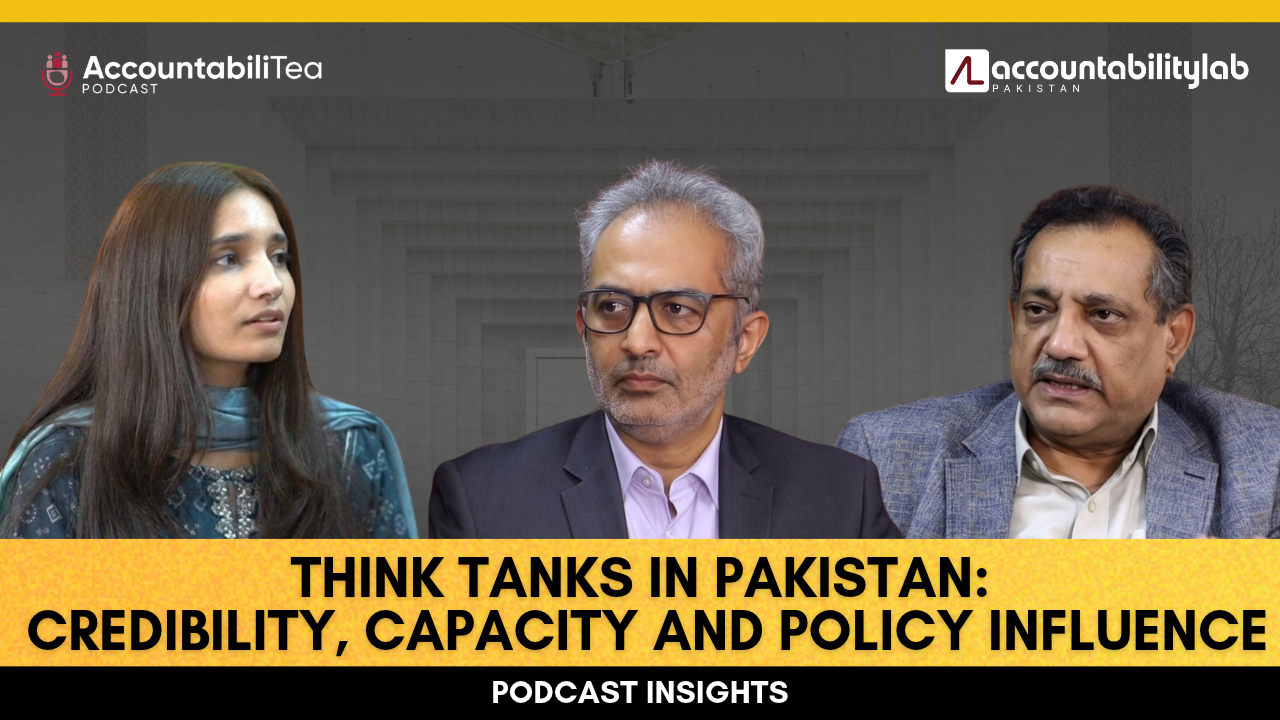
Who decides what Pakistan’s think tanks research, and what happens to that work once a report is published? In a conversation with Momina Sahar, Dr Ali Salman, founder and executive director of the Policy Research Institute of Market Economy (PRIME), and Dr Shafqat Munir Ahmed, head of the Resilient Development Programme at the Sustainable Development Policy Institute (SDPI), discuss how think tanks set priorities, sustain research, and reach policymakers and communities. They also consider what influence looks like when recommendations are not adopted, and how research can keep neglected questions in public debate.
Think Tanks as a Bridge Between Research, Communities and Policy
Dr. Shafqat argues that one of Pakistan’s basic problems is conceptual confusion. Think tanks are often treated simply as NGOs. In contrast, civil society organisations, activists, humanitarian organisations, trade unions, and think tanks play different roles. He stresses that neither the NGO label nor the think tank label is inherently problematic; the difficulty arises when the distinctions are blurred, and the space available to civil society institutions becomes restricted.
He also points to fragmentation within the sector itself. Pakistan has many think tanks, including government-funded institutions, but they have not fully emerged as a community. Academic research can also remain disconnected from policy needs. Think tanks, in his view, occupy the space where research is translated into policy and where communities can be connected to government.
The Missing Ecosystem: Government Demand and Local Funding
Ali Salman traces the development of modern think tanks to an ecosystem in which policymakers actively seek independent advice and society is willing to finance intellectual work. In Pakistan, he argues, both elements remain weak: explicit government demand is limited and local funding mechanisms are underdeveloped. As a result, the think tank movement has largely grown through external models without all the supporting pillars that sustain such institutions elsewhere.
For Ali, a think tank should not judge its value only by whether a government directly adopts its recommendations. Its role is to remain relevant, provide credible policy advice for public consumption, and identify opportunities to influence policy when the political environment allows.
Both guests reject the idea that donor funding automatically makes research biased. Ali explains that PRIME works around a clearly defined mission and does not take assignments that contradict it. Credibility is strengthened by bringing academics and external experts into research teams, adding intellectual depth and exposing the work to people recognised in media, academia and government. He is also explicit that a think tank may have a defined policy position, but that position should be transparent.
Dr. Shafqat describes a similar discipline at SDPI: the organisation first establishes its own annual research agenda, then looks for calls for proposals that match that agenda. Where donor priorities differ from local realities, the inception process provides room for negotiation and adaptation. His central test is relevance and impact: “grabbing funding is not the first priority.” The first question is what the work will do for people and what effect it can have on policy.
Why Local Think Tanks Receive Less Recognition
Ali locates much of the problem on the supply side. Local think tanks can and do achieve recognition in the media, parliament and government, but their reach is constrained by limited budgets, organisational size, human resources and the scope available for independent research. International organisations also compete strongly for skilled researchers because they can often pay more.
Global indices and international comparisons receive additional attention because they are designed for cross-country visibility and are easily translated into rankings and headlines. Local think tanks therefore face a competition not only of research, but also of information, perception and data analysis. Ali suggests that collaboration among think tanks across developing countries could help produce more grounded alternatives.
Dr. Shafqat argues that think tank research should not end with delivery to policy makers. SDPI increasingly begins with community consultations, shares findings back with communities and distinguishes recommendations for national, provincial, district and community audiences. This creates two dimensions of success: influence on policy and impact on the lives of people affected by that policy.
This approach also broadens the audience for research. Young people, civil society organisations, local governments and communities may not sit inside formal policy circles, but they are directly affected by long-term policy choices. Research therefore needs pathways that take evidence beyond elite policy spaces.
Data and the Credibility of Research
Both guests identify data collection as a practical constraint. Large surveys require permissions and, in many cases, district-level NOCs. Ali argues that this raises costs and delays original data collection. At the same time, he stresses that credibility depends on transparency: data sources and methodology should be open to scrutiny so that researchers and academics can examine how findings were produced.
Dr. Shafqat describes triangulation as central to research practice, combining surveys, key informant interviews and focus group discussions to validate findings and compensate for the limitations of any single method. He does not object to permission requirements in principle, but argues that the process should be prompt, predictable and easier to navigate, especially where researchers have already disclosed the location, audience and scope of the proposed work.
A recurring theme is that research alone does not create influence. Dr. Shafqat estimates that research may represent only part of the value chain; the rest involves spreading ideas, advocacy, media engagement, conversations with decision makers and building constituencies around policy issues. Without these networks, the influence of even strong research remains limited.
He also calls for greater openness from government. Working papers behind major economic and sectoral policies should be published so that academics, think tanks and experts can debate them before decisions are finalised. Even without direct government funding, making policy questions and background papers public would create a stronger local market for evidence and ideas.
AI as a Research Tool – Not a Substitute for Ideas
Ali sees artificial intelligence primarily as an advantage. It can speed up tasks such as compiling data, producing tables and reviewing multiple reports, but he insists that analysis must remain the researcher’s own and that the use of AI should be transparent. For think tanks, the value lies in efficiency rather than outsourcing judgement.
Dr. Shafqat similarly treats AI as a tool for literature review, coding, graphics and tables. The original ideas, prompts and critical reflection must still come from researchers. He also stresses ethical practice and acknowledgement of the tools used. The central principle is simple: AI can assist the work, but it should not replace independent thinking.
Building the Next Generation of Think Tanks
Ali and Dr. Shafqat both see room for more think tanks in Pakistan. Ali argues that long-term think tanks keep policy questions and ideas alive even when governments and political priorities change. He urges ministries to frame policy questions proactively and take them to universities and think tanks rather than waiting for donor agencies to define the agenda.
Dr. Shafqat adds that devolution has increased the need for think tanks at provincial and district levels. He questions whether think tanks should simply be treated under charity-registration frameworks and argues for a more suitable mechanism that would also make local fundraising easier. Stronger links with local industry could reduce dependence on international funding and generate research around locally defined economic, environmental and social problems.
He describes think tank founders as “intellectual entrepreneurs”: people who identify a demand for ideas, package those ideas and build networks around them. A successful think tank does not necessarily require a large institution. Focused teams and networks can be effective if they connect people from universities, government, politics, business, and the next generation of researchers.
Link to Podcast: