
NEWS
IN BRIEF

The landscape for humanitarian work and philanthropy around the world stands at a critical juncture. Questions are being raised about the credibility of the evidence these efforts produce and how far they translate into tangible development. In Pakistan, these challenges are compounded by limited public understanding of civil society’s mandate [...]
SHARE
The landscape for humanitarian work and philanthropy around the world stands at a critical juncture. Questions are being raised about the credibility of the evidence these efforts produce and how far they translate into tangible development. In Pakistan, these challenges are compounded by limited public understanding of civil society’s mandate and the distinction between charity and relief on the one hand, and the longer-term work of research, accountability and advocacy on the other. Local philanthropy and corporate social responsibility largely operate within a charitable framework, even as civil society organisations generate evidence that others rely on. Their work also requires them to scrutinise the state and challenge institutions that resist change. That tension is not separate from their contribution to development; it is part of how civil society advances accountability, democratisation and human rights.
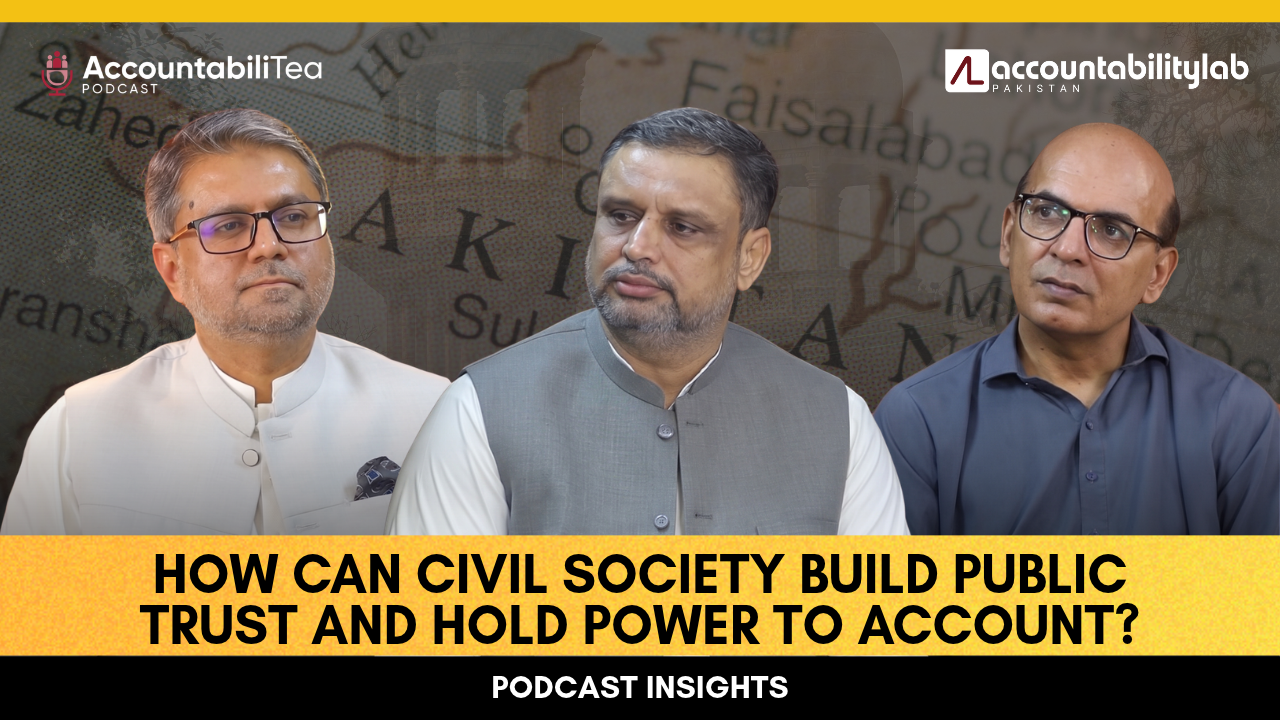
To explore these questions, Asif Farooqui, Director of Programs at Accountability Lab Pakistan, sat down with the Executive Director of the Centre for Peace and Development Initiatives (CPDI), Mukhtar Ahmed Ali, and Governance and Public Policy Expert, Rashid Chaudry, to discuss how civil society in Pakistan is viewed and what its role demands. Their conversation describes a sector that is valued when it provides services or evidence, yet contested when it challenges entrenched assumptions and discretion. It points to a double task: the state must regulate without suffocating civic work. At the same time, civil society must build confidence through stronger evidence, clearer communication and a more resilient operating model. Please read on to have a peek into the discussion.
The conditions of trust
Mukhtar Ahmed Ali rejects the idea that trust has moved in one direction. He recalls villagers praising organizations for relief, training, and rehabilitation after disasters, and public institutions seeking civil society support. He also points to policy and institutional gains that followed sustained advocacy, including commissions and protections related to women’s rights, harassment, and human rights. He notes that political actors cite election-related evidence from Free And Fair Election Network (FAFEN), often when they are in opposition. These examples show that civil society is not outside the state or society: it has helped shape institutions and provides knowledge that public actors use.
But this recognition is uneven and often transactional. An organization may be valued as a service provider, technical partner, or source of data while its criticism is treated with suspicion. The political use of evidence also cuts both ways: parties may cite monitoring when it supports their case and contest it when it does not. The discussion therefore distinguishes operational cooperation from deeper public legitimacy. Access to officials does not necessarily mean trust, and citation of a report does not guarantee acceptance of the independent role that produced it.
The speakers also resist a simple division between a credible state and an untrustworthy civil society. Mukhtar argues that reputational weakness is widespread across institutions, while acknowledging that poorly performing organizations damage the sector as a whole. His ambivalent analysis makes room for institutional criticism without excusing civil society’s own shortcomings.
Regulation has swung between neglect and control
In an earlier period, organizations could register quickly and then face little scrutiny for years, even when the chosen legal form did not fit their purpose. In the later period, Mukhtar describes approval requirements for foreign funding, repeated and layered registrations, project-specific memoranda, overlapping federal and provincial demands, and banks refusing transfers. Rashid places the tightening in the context of the Economic Affairs Division’s (EAD) policy and INGO policy processes around 2013-14, followed by legislative efforts that, in his account, did not produce a settled framework. The result was not simply more accountability; it was uncertainty and arbitrary administration.
The criticism is not an argument against oversight. Mukhtar explicitly accepts the need to prevent illegal activity and protect public interest. His proposed standard is proportionate regulation: recognize civil society as a social need, facilitate its legitimate work, and maintain oversight that can detect wrongdoing. He argues that policy development should include consultation and research, and that implementation should be predictable, time-bound, and supported by officials capable of assessing organizations. The critical gap is therefore institutional design: regulation is framed as control, while the practical systems for fair, capable, and consistent accountability remain weak.
A credible settlement must make obligations clear to organizations and regulators alike: consistent registration and reporting rules, reasoned decisions, realistic timelines, a route to appeal, and checks that are proportionate to risk. Without reciprocal accountability, each side can interpret the other’s conduct as bad faith.
The foreign-agenda debate
Rashid’s account is candid about dependence. He maintains that donors have development or foreign-policy priorities; local organizations sometimes align with available calls because they need to survive. He acknowledges that funded work can feel imposed and that locally recognized needs may not always align with donor priorities. At the same time, he argues that sometimes social issues become contested precisely because the approach to address them challenges prevailing societal norms. However, the presence of such tension, by itself, does not prove that an agenda is foreign.
Mukhtar adds an institutional point: donors commonly agree broad areas of cooperation with government before inviting organizations to propose work within those areas. In his view, objections to the priorities should be raised at that level, while organizations remain answerable to Pakistani law and constitutional limits. His argument challenges the selective suspicion directed at civil society funding. Yet it does not remove the strategic question Rashid raises: even a lawful, government-agreed funding stream can shape which problems receive sustained attention and which capabilities are built.
The debate offers a more grounded way to test the “foreign agenda” claim. Ask whether a project addresses a demonstrable local problem, whether affected people influence its design, whether the activity is consistent with constitutional and legal commitments, and whether the organization can explain its funding and results. On that test, work on girls’ education, torture prevention, child labour, freedom of expression, or access to information is not made foreign by the origin of a grant. But organizations still need to disclose how donor priorities affect choices, and how they protect their mandate when funding shifts.
Rights work creates friction because it changes who can question power:
Examples given during the podcast moved the debate from abstract “values” to everyday power. A police officer who dismisses a property complaint because the alleged dispute is between a son and his mother substitutes social expectations for legal inquiry. Right-to-information procedures reduce dependence on personal connections by allowing an ordinary person to request records without first finding a patron. Greater visibility and recognition for transgender people challenge exclusion that had been treated as normal. In each case, rights-based work changes who is heard and which standards govern decisions.
The deeper implication is that conflict is not always a sign of failed engagement. Civil society’s watchdog role is expected to produce disagreement where it exposes arbitrary discretion or entrenched privilege. The relevant question is whether disagreement is handled through law, evidence, and dialogue, or recast as disloyalty and foreign influence. This does not mean every claim made by an organization is correct. It means the state should answer criticism with transparent reasoning and lawful process, while organizations must substantiate their claims and correct errors.
The speakers’ examples also show why public communication matters. Constitutional provisions may be formally established yet remain inaccessible if laws are notified in English and the government does little to explain them. Civil society often translates legal entitlements into usable public knowledge. That is a public function, but it can be misunderstood when rights are presented as alien terminology rather than protections already grounded in Pakistani law and constitutional history.
Funding shocks expose a sustainability problem, not just a budget gap:
Rashid describes organizations adapting after a major contraction in funding, including in democracy programming, and argues that work can continue at a smaller scale. Mukhtar similarly distinguishes contract-driven organizations from those with a deeper commitment to their mission. Their point is not that funding does not matter: evidence collection, organizational capacity, and the scale of intervention can shrink when resources disappear. Rather, they reject the idea that the need itself disappears when a donor changes priorities.
The speaker proposeda broader domestic funding culture. Government, businesses, and local philanthropy could support public-interest work, while philanthropy moves beyond relief and charity toward investment in institutions, rights, research, and accountability. Mukhtar recalls voluntary and philanthropic traditions, including All Pakistan Women’s Association (APWA), educational institutions, and the Aligarh movement, as evidence that civic initiatives predate contemporary donor funding. Donors, he also notes, have helped elevate issues such as environmental protection and minority rights that did not consistently attract local philanthropic support.
There is a tension here that deserves attention. Local funding can reduce exposure to external policy swings, but it will not automatically be independent or equitable. Domestic funders may also have preferences, political ties, or narrow definitions of acceptable work. The goal should therefore be diversified funding with safeguards for independence, rather than replacing one dependency with another. Organizations need to protect their mandate, disclose constraints, and avoid expanding into unrelated areas simply to chase short-term grants.
Is Local research constrained by a weak demand system?
The discussion challenges the claim that local knowledge is absent. Mukhtar names the Human Rights Commission of Pakistan (HRCP) and the Free and Fair Election Network (FAFEN) as Pakistani organizations whose reports are used, including by politicians and international actors. But he accepts that much of the sector is stronger at advocacy and convening than at rigorous, systematic research. He identifies a reinforcing cycle: donors have at times favored action-oriented projects over in-depth studies; government does not consistently commission or use local research; and officials’ confidence that they already know the answer reduces demand for inquiry. With few reliable users of research, organizations have fewer incentives to invest in methods, data quality, and long-term evidence.
The remedy is not simply to tell civil society to “do more research.” Public institutions must create demand by commissioning studies, using findings in policy, and explaining why evidence was accepted or rejected. Civil society organizations, in turn, need to invest in sound methods, transparent limitations, and engagement with affected communities. Mukhtar’s reference to participatory research explains that expertise cannot replace local knowledge.
The speakers accept that data can be misused and that security institutions have legitimate responsibilities. Their concern is proportionality: restrictions should be based on a clear risk assessment and should not stop lawful research or unnecessarily compromise civil liberties. A functioning approach would distinguish sensitive from non-sensitive data, use clear protocols, and apply safeguards consistently across fieldwork and digital handling. Otherwise, restrictions can suppress the evidence needed for better policy while leaving other data vulnerabilities unaddressed.
Digital reach cannot replace organized dialogue
Mukhtar recognizes that smartphones and social media give individuals, including people in remote areas, a wider platform. He argues, however, that civil society’s distinctive contribution is to create spaces where people can compare experiences, test assumptions, build a shared analysis, and plan collective responses. Digital tools can host that process, but a single viral post does not provide the same deliberation or “reality check.” The point is not to romanticize formal organizations; it is to preserve the work of collective interpretation and problem-solving in both physical and virtual settings.
This insight applies to government as well. Policy made by a small group relying on a few impressions can miss the costs and consequences visible to communities. Consultation has value when it changes the evidence base or the decision. Civil society’s role is therefore not only to transmit community demands upward, but also to help communities refine claims and understand competing constraints.
What the discussion asks of each side
For government and regulators
Build a proportionate framework through meaningful consultation, publish clear requirements and timelines, and explain decisions. Invest in staff capacity so due diligence is competent rather than checklist-driven. Treat audits and lawful reporting as part of accountability, and use questions, inspections, and remedies that match the risk. Commission local research and show how evidence informs policy. Apply security safeguards to protect both legitimate state interests and citizens’ freedoms.
For civil society organizations
Explain priorities, funding, methods, and results in language communities and officials can understand. Strengthen research quality alongside advocacy, including transparent methods and acknowledgment of uncertainty. Improve governance and financial discipline across the sector so weak practice does not undermine credible organizations. Modernize operating models and use cost-effective technology, while ensuring efficiency does not displace community participation. Diversify funding without surrendering the core mandate.
Credibility requires both independence and answerability:
The conversation does not offer a simple bargain in which civil society earns trust by becoming less critical, or the state earns legitimacy by tightening control. It describes a more demanding relationship. Civil society must be independent enough to question power and answerable enough to show how it works. The state must be capable of oversight and willing to hear evidence that complicates its assumptions. Communities must be treated as sources of knowledge and participants in decisions, not merely beneficiaries or audiences.
Link to Podcast:
https://youtu.be/qWiZLBzRRMM