
NEWS
IN BRIEF

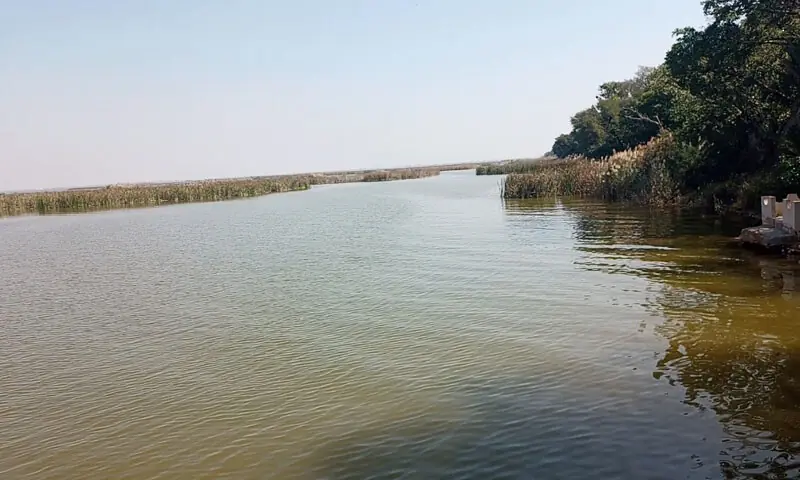
Once a thriving freshwater reservoir and a sanctuary for thousands of migratory birds, Haleji Lake is now facing a slow and alarming decline. Despite its lush green surroundings and Ramsar-protected status, the lake has suffered from eight years of halted Indus inflows, turning it into a stagnant and shrinking water body. As water levels drop, biodiversity, bird populations, and local livelihoods are increasingly at risk raising urgent questions about wetland conservation, governance gaps, and Pakistan’s commitment to protecting its natural heritage.
SHARE
THATTA: The greenery leading to Haleji Lake — tall eucalyptus trees, neem, peepal, coconut and other wild vegetation — point to the high water table level in the area. Yet the lake is not doing so well. It is slowly drying.
A recent visit to Haleji Lake organised by Accountability Lab Pakistan in collaboration with Green Media Initiatives and the Sindh Wildlife Department (SWD) helped highlight several issues with this sanctuary.
A man-made lake, Haleji, located some 88 kilometres from Karachi, was constructed during World War II, between 1940 and 1943, by the British rulers in India to provide water to their troops stationed in Karachi. According to In Charge Haleji Wildlife Sanctuary, Sohail Ahmed Khoso this was initially a saltwater lake. But then the British created a small natural depression into a reservoir fed by a feeder canal from the Indus River. “That is how fresh sweet water from the Indus was stored here and supplied to Karachi,” he said.
“Soon after, migrant birds from Siberia started frequenting here. Following the Ramsar Convention in 1971, Haleji Lake was included in the list of protected Ramsar sites, which includes marshes, lakes, mangroves and man-made sites. So far some 172 nations are signatories to the Ramsar Convention of which Pakistan is also one,” he said. “The SWD also made Haleji Lake a protected area in 1972.
Water levels are dropping due to stoppage of inflows from the Indus for eight years now, official says
“We have some 225 wetlands in Pakistan of which 19 are Ramsar wetlands. And nine of those 19 Ramsar wetlands happen to be in Sindh of which the most important lake with so much biodiversity is Haleji Lake,” Mr Khoso pointed out.
Of late, Haleji Lake has become the biggest victim of water scarcity, which carries its consequences. With the levels of water in the lake falling rapidly, the food for the migratory birds is also reduced in quantity. The birds flying by this route include Northern Pintail, white-tailed Lapwing, Egyptian Vulture, Pheasant Tailed Jacana, ducks, Waders, pelicans, Mallards and so many more. The SWD carries out a census of the birds. It is worrisome to note their numbers may be decreasing.
The reason behind the water scarcity at Haleji Lake, as pointed out by Mr Khoso, is the stoppage of inflow of sweet water for eight years now.
“We are no longer getting water from the Indus River. It is being diverted towards water projects such as the K-IV before it reaches here. Earlier, water to Karachi was going from here. With no inflow and no out flow either, Haleji Lake has become a stagnant water body,” he said.
Ecologist Rafiul Haq, added to that by saying that wetlands support life forms. Therefore they are seen as unique ecosystems. “Wetlands also have economic value,” he said.
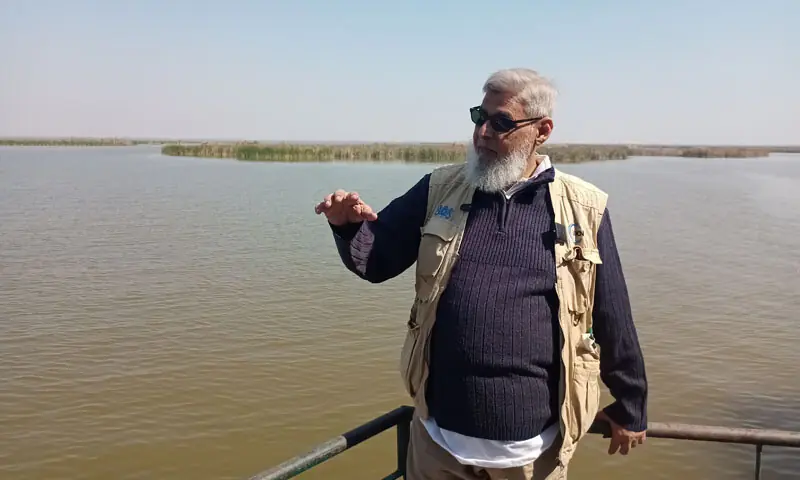
“One-third of our planet is water and nine per cent of it is taken up by wetlands. It amounts to around 63 million hectares of water bodies, which earns $3.4 billion per year for services such as water purification and supply, flood protection, recreation and tourism,” he said.
But he also regretted that all over the world and not just here in Pakistan, the degradation rate of wetlands is going up. “According to an estimate, it is happening at a rate, which is threefold the rate of deforestation due to climate change. Urban expansion, agriculture land use, construction of dams, pollution and climate change are all contributing factors here. It is also a sad estimate that one-fifth or 20 per cent of the remaining wetlands in the world may vanish by 2050 without urgent action,” the ecologist sighed.
“All over the world, World Wetlands Day is celebrated on Feb 2 to mark the 1971 signing of the Convention on Wetlands in Ramsar, Iran. It is important to celebrate this day and understand the dangers befalling our wetlands.
“Naturally, water bodies grow in size during the monsoon and later as the water level goes down they shrink. That’s when people, thinking that the water will not return from the area which dried up, use that land for agriculture. Dams also hurt lakes. When you hinder the natural flow of water you hurt water bodies. Don’t create such issues that disturb the dynamics or water cycles of water bodies.
“We may be signatories to the Ramsar Convention but we are not really doing our bit by not keeping our promises. We have governance gaps when it comes to caring about our natural resources. Our Ramsar commitments are there but their implementation is weak,” the ecologist reminded. “With the migratory birds, the plantation, the tourism which also helps the local community find its own ways of earning livelihoods, Haleji Lake is a biodiversity hub. It requires wise use. Don’t use it to deplete it. Coexist with it,” Mr Haq urged.
About the Author:
This blog is written by Shazia Hasan who is a senior staff reporter for Dawn.
Note: This blog was originally published on Dawn News on February 3rd 2026 and can be accessed here.